Pardon the 15-month gap between blogs, but 2013 was a hectic year, and it's taken me the first few months of 2014 to fully recover. I won't be writing as regularly as I did when I was in school and had to post each week for class, but I also won't be quiet for such a long time!
In May 2013 we had a mini-tornado and hail storm rip through our area, and the combination knocked down my portable electric fence, and actually moved my very heavy A-frame chicken house. I didn't realize the problem and let the dogs out for a walk after the storm had cleared. They decimated the flock; only 9 hens escaped (see my 9/12/12 blog, "On predators and prey").
The biggest difference between now and previous to the storm is that I've rebuilt the flock with hens but no roosters. Many people ask if hens can lay eggs without a rooster around, and the answer is yes. The eggs are not fertilized so they won't hatch, but they are just as tasty and nutritious.
I've been rooster-less for almost 10 months now, and I've got to say the "girls" seem much happier. Roosters are rough and just plain brutish when mating, and their spurs can leave the hens' backs bloody and bare. And while I've had some tame roosters who were easy to work around, I've also had roosters who were just plain mean. The mean ones attack anyone who goes near the chicken house or the hens, and that obviously makes things difficult.
But least I get accused of misandry (hatred of males), I will admit that roosters can be helpful. They are always on the lookout for predators, while foraging hens just focus on eating. Many times I've heard a rooster cackling or scolding, only to go outside and discover a threat, such as a dog, coyote, or chicken hawk.
Also I have lost a few customers because some people only want fertilized eggs, either to eat (they think they are healthier), or to hatch.
So for now, we're staying rooster-less, and my Happy Hens are even happier than before!
Sunday, March 16, 2014

Monday, December 3, 2012
Fun facts about hens
I've learned a lot about chickens during the 2 ½ years that
I’ve been raising them. The biggest thing I’ve learned is that there’s a lot to
learn! This week I wanted to share with you some fascinating (at least to me)
things I've learned about hens.
First of all, as I mentioned in a previous blog, young hens
(called pullets when they’re less than one year old) do not start laying until
they are 5 or 6 months old. And when they start laying, it’s anything but
regular. A newly laying pullet might produce one small egg or a strangely
colored egg every few days; I've even had pullets whose first 5 or 6 eggs were
laid without a shell. So it takes a while for the pullets to get good at
egg-laying.
Once they are mature layers, each hen will lay, on average,
one egg every 25 hours. So the laying time for an individual hen shifts to one
hour later each day, until they would be laying in the early evening. At that
point, they normally hold off laying until the next morning, and then the one
egg every 25 hour schedule starts up again.
Have you ever wondered what makes the yolk of an egg yellow?
As I’m sure we’re all aware, the skin of most chickens is somewhat yellow, and
this is due to a considerable amount of pigment, which comes from green feeds
and yellow corns. In addition to coloring the chicken’s skin yellow, this pigment
also gives the egg yolk its yellow color. Free-range chickens, such as mine,
have plenty of access to green feeds and thus tend to lay eggs which are a richer
color of yellow than hens raised in factory farms.
Over time, however, the pigment stored in the hen’s body is
used up. And it is used in a particular sequence. So you can look at a hen, and tell how many eggs she's laid. The pigment is first
bleached out of the vent (rear part of the hen where the egg comes out),
followed by her earlobe, beak, and feet.
So while in my flock I have a mix of pullets and hens
ranging in age from 1-3 years, I can easily tell the youngest from the oldest
by how bleached out they are.
While the rate of egg-laying is greatest in the hen’s first
year or two, a healthy hen can actually lay eggs for 10-12 years. She may not
lay many eggs, perhaps only one every 3 or 4 days, after the age of 4, but she
will still be laying.
Most hens, unfortunately, never reach old age. Hens raised
in factory farms lay for a year or two and then are culled (a nice way to say
killed), when the cost of their feed exceeds the income generated from their
egg-laying.
My hens, on the other hand, don’t have anything to worry
about. I am committed to keeping them as long as they are healthy and happy,
regardless of how many eggs they lay.
Next blog I’ll tell you why I have a totally different
attitude towards roosters.
Sunday, November 18, 2012
The pullets are laying!
For some of you, I’m sure the title of this week’s blog
means nothing. But to me, it’s a milestone for my latest batch of chicks
(hatched in May, 2012). Let me explain.
First of all, what’s a pullet? A pullet is a female chicken
less than one year old. (In case you’re interested, a male less than one year
old is called a cockerel.)
Chickens grow really fast, but pullets don’t start laying
until they are five or six months old. At that age they are far from
full-grown, but they can still lay “eggs.”
I put the term in quotes because the first few weeks of
egg-laying are somewhat inconsistent. A mature hen will lay one egg about every
25 hours, but pullets are much less reliable.
When they first start laying, it might be only one egg every
three or four days, and the eggs they lay are typically quite small (golf ball-sized,
or in some cases, grape-sized). Also there is less consistency in the color; a brown-egg
laying breed, such as a New Hampshire Red, might lay white eggs, or a Leghorn
(known for white eggs) might lay light brown eggs.
So it takes the pullets a bit of time to get this all sorted
out.
My pullets have been laying since early October, but it has
only been this week that they seem to have perfected their skills. For some
strange reason, they’re all on the same schedule, and this week I've gotten a
lot of appropriately colored, high quality eggs.
Their timing is perfect since my oldest hens (hatched in
April and May, 2010) are nearing the end of their egg-laying years and
producing, on average, only one egg per hen each 30 hours (yes, I keep track of
this).
I'm so proud of my young ladies! Here’s a picture of some recent pullet eggs I collected from the nesting box:

Sunday, November 11, 2012
Bees gone wild!
I like to think that I know my bees, and that they know me.
I know it sounds a little crazy, but we country folk tend to develop
relationships with our critter companions.
This week I found out that I was totally wrong about me and
the bees. I don’t think we’re friends at all.
In preparation for the upcoming cool weather, I decided to
inspect my hive to ensure they have an adequate honey supply to winter over (if
not, I would periodically give them some sugar water), and that the queen is
still healthy and laying eggs (her main job).
Weather this week has been windy, and at times a little
cloudy. Generally speaking, you don’t want to inspect your hive when it’s windy
or cloudy because the bees are less settled under these climatic conditions.
You definitely don’t want to inspect a hive when it’s both windy and cloudy.
I was so busy this week that the only time I had available
to inspect the hive was on a windy and cloudy day. I should have waited, but I
didn’t. I thought I could deal with it, but I couldn’t. I’m paying the price
now.
Everything was fine until I lifted the top cover off the
hive, but just then a gust of wind hit, and angry bees flew up out of the hive.
I was wearing gloves but not a face net or bee suit. I got stung 5 or 6 times
on the face.
Fortunately I’m not allergic to bee stings, so it was a
little painful, but not too bad. Here’s what I looked like for a few days:

In the future, I’ll be more careful about timing my hive
inspections to coincide with sunny, windless days.
And maybe next time I’ll
wear my bee suit and face protection. Knowing me, probably not!
Monday, November 5, 2012
Where do chickens come from?
People sometimes ask me, generally with a straight face, where my chickens come from. The answer is, from eggs, of course!
But what I've learned is that there are several ways to get chickens from eggs. Strange as it sounds, I buy most of my chicks online, from a Texas company called Ideal Poultry. They have a huge selection of chicks, and the prices are quite reasonable.
Chicks you order online are delivered by the US Post Office. This is possible because newly hatched chicks don't eat or drink for 48-72 hours. So as long as they reach their destination within this time, they'll be fine. The chicks are packed in cardboard boxes holding a minimum of 25 chicks (any fewer chicks and they might die because they need the warmth of other chicks to help maintain their body heat).
My tiny country post office gets a lot of boxed chicks, and they know exactly what to do. I normally call the post office a few days before the chicks are expected so they'll be on the lookout for my shipment.
The boxed chicks typically arrive at the post office with the first mail delivery around 5:00 am. The morning clerk calls me as soon as the mail comes in so I can pick up my chicks, even though the post office will not be open for almost 3 hours. Once I pick up the chicks I inspect the box so I can report to Ideal Poultry if any chicks look sick or have died in transit (that's never happened for any of my shipments, fortunately).
The other way I have gotten chickens is to hatch my own. This way is harder and contains more uncertainty. Since I don't have an incubator (a container for holding eggs at a constant temperature and humidity until they hatch), I have to rely on one of my hens to sit on the eggs until they hatch. This is hard on the hen, and hard on the eggs, since a hen will often break a few eggs she intends to hatch by moving around in the nesting box. So I have found it much easier to just order chicks online.
Here's a picture of the chicks I got in May 2012. They were less than two days old when they arrived.

But what I've learned is that there are several ways to get chickens from eggs. Strange as it sounds, I buy most of my chicks online, from a Texas company called Ideal Poultry. They have a huge selection of chicks, and the prices are quite reasonable.
Chicks you order online are delivered by the US Post Office. This is possible because newly hatched chicks don't eat or drink for 48-72 hours. So as long as they reach their destination within this time, they'll be fine. The chicks are packed in cardboard boxes holding a minimum of 25 chicks (any fewer chicks and they might die because they need the warmth of other chicks to help maintain their body heat).
My tiny country post office gets a lot of boxed chicks, and they know exactly what to do. I normally call the post office a few days before the chicks are expected so they'll be on the lookout for my shipment.
The boxed chicks typically arrive at the post office with the first mail delivery around 5:00 am. The morning clerk calls me as soon as the mail comes in so I can pick up my chicks, even though the post office will not be open for almost 3 hours. Once I pick up the chicks I inspect the box so I can report to Ideal Poultry if any chicks look sick or have died in transit (that's never happened for any of my shipments, fortunately).
The other way I have gotten chickens is to hatch my own. This way is harder and contains more uncertainty. Since I don't have an incubator (a container for holding eggs at a constant temperature and humidity until they hatch), I have to rely on one of my hens to sit on the eggs until they hatch. This is hard on the hen, and hard on the eggs, since a hen will often break a few eggs she intends to hatch by moving around in the nesting box. So I have found it much easier to just order chicks online.
Here's a picture of the chicks I got in May 2012. They were less than two days old when they arrived.
Sunday, October 28, 2012
Breeds and types of chickens
I don’t know how many chicken breeds there are in the world,
but the American Poultry Association recognizes over 100 different breeds. There are a lot of ways to categorize the
breeds of chickens, but one way I find most helpful is based on their function.
By my categorization,
there are three types of chickens: those which are best at laying eggs; those
which are best at producing meat; and dual-purpose chickens which are not the
best egg-layers, and not the best meat-producers, but moderately good at both
functions.
As with many small chicken producers, I have chosen to raise
only dual-purpose breeds. There is little
waste in raising dual-purpose chickens since hens past their prime for
egg-laying and extra roosters can be harvested for their meat. In addition to focusing on dual-purpose chickens,
I also prefer those which are considered hardy (disease resistant) and which are
good foragers (forage for a high percentage of their food needs as opposed to
needing chicken food).
One last criterion I use for selecting chickens has to do with
recognized heritage breeds. A heritage breed
is one that was used by our forebearers (in the 1700’s, 1800’s, or 1900’s), but
is now in danger of becoming extinct because of modern poultry production facilities.
The American Livestock Breeds Conservancy has a wealth of information
about heritage chicken breeds and other livestock.
So while my chickens are all dual-purpose, I currently have
5 different breeds: Wyandottes, Delawares, New Hampshires, Dominiques, and
Aracuanas. All these breeds are listed by the American Livestock Breeds
Conservancy. The first four breeds I
mentioned lay brown eggs; the Aracuanas lay greenish blue eggs. I would love to have some Chanteclers, which
are close to becoming extinct, but have not been able to find any.
Next week…Where do chickens come from?
Sunday, October 21, 2012
About my chickens
A
few weeks ago I wrote about my beekeeping activities. This week I’ll start telling you about my chickens. There is a lot to tell!
People often ask why I raise chickens. The simple answer is that I like to know where my food
comes, and I like to know that my food is raised humanely. I don’t know of any
way to be absolutely certain about humane conditions unless I’m doing it
myself.
So about
5 years ago I got interested in raising chickens for meat and for eggs.
As usual, I did a lot of research before getting any chickens.
What I learned is that chickens are easy to keep and have few health problems
if raised correctly. I decided that my chickens would free range most of the
day (once the dogs were up), but realized that I needed to protect them
from foxes, coyotes, and other predators at night.
Here’s
a picture of my solution to the predator problem.

All night and in the morning until the dogs are put up, my
chickens are protected by an electric fence around their houses. The house on
the left is where most of the chickens sleep at night and where the hens lay
their eggs. The hoop house on the right is additional roosting space; I also
use it to house baby chicks until they are big enough to mingle with the older
chickens.
The electric fence and both chicken houses are portable, so
I can move the chickens to fresh ground every week. This is much healthier than
a traditional setup where chickens are raised and live in a chicken yard that
has to be cleaned every few months. When my chickens get stinky, I move them to
another location. The houses can be
hooked onto the tractor, the truck, or my John Deere Gator utility vehicle for
easy transport. The electric fence folds up and can be easily carried.
Most days I let the chickens out after walking the dogs, and
they free range over our property during the day. Chickens are happiest when
they can peck, scratch, and forage. My chickens eat bugs, lizards, small snakes,
seeds, and other tasty tidbits they find. Here are some pictures of my happy
foragers.

Sunday, October 14, 2012
A death in the family
A few weeks ago I wrote about my carefully orchestrated schedule
to keep predators and prey separated. This week, in spite of my efforts, there
was a death in my family. My beloved orange and white tabby, Orange Juice (OJ),
is gone, and my own dogs killed him. This is painful to admit.
Before I tell you how OJ died, I want to tell you about his life. Like so many of my critters, I don’t know where he came
from or what his story was. But I loved him dearly.
One cool spring night in March 2008, while putting food
outside for the barn cats, I noticed a large, scraggly, orange and white tabby cat
hanging back near a grove of trees in the yard. I called to him, but he ran
off.
Every night when I put out the food the stray cat was
there, but he never let me get close. I started sitting by the door and calling
to him each night; gradually he came closer and closer.
By August, the stray finally let me touch his head, and
the rest was history. A week later I was able to get him into a carry cage to
go to the vet. He had the usual afflictions of a stray: fleas, ticks, ear
mites, and internal parasites. My vet said he was about 10 years old, and since
he had not been neutered, I had that done before I brought him home.
My then 2-year old granddaughter was visiting at the
time, and while I called the new cat Orange (because of his color), she
insisted his name should be Orange Juice. OJ’s the name that stuck.
Normally a male cat neutered so late in life will be
rather unpleasant and continue to mark his scent in the house, but OJ was a
perfect gentleman. He quickly became an indoor cat, and filled an empty space
at the foot of our bed, day and night.
OJ was full of life, but also full of mischief. When my
husband and I played cards at night, OJ often jumped in the middle
of the table and batted the cards onto the floor. When I sat at my desk to do
school work, he would sit in my lap and purr his encouragement. Often when I
petted him he would playfully bite my hand.
Unfortunately, OJ also liked to taunt the dogs, running
to get inside the house just before they got to him. Other times he would sit
silently by the side of the road while the dogs ran obliviously by him, then
turn to hiss when they were too far away to catch him. I’m sure it never
occurred to OJ, but I knew that as he got older and ran slower, this might
become a deadly game.
And so it did. Last Sunday, I heard the dogs barking by
the garage, and went out to find OJ on the ground surrounded by my four younger
dogs. We quickly took him to the Animal Emergency Room. He had a punctured
lung, and several bite wounds, but did fairly well throughout Sunday night and
early Monday morning.
The Animal Emergency Room is only open nights and
weekends, so on Monday morning I picked up OJ and drove him to my regular vet.
He purred and licked my hand as I held him in the car. I was optimistic that he
would be okay.
But it was not to be so. My vet knows that I won't allow animals to suffer because I'm afraid to let them die. When OJ became
distressed Tuesday morning, she euthanized him. I know it was not an easy
decision for her, because she knew OJ too, but it was the right
decision.
We buried OJ Tuesday afternoon, near the same grove of
trees he once hid in when I called to him at night. I can see his grave from my
door.
I know my dogs had no malice aforethought —they are, as I
have told you, killing machines, and were just doing what a pack of dogs will
do. But I’ve struggled unsuccessfully all week to forgive and forget. I’m not
sure I'm capable of doing so.
In the meantime, I think again how fragile life is. And I
am reminded of the importance of keeping my predators separated from their prey.
Sunday, October 7, 2012
Country wisdom
Because I’ve lived in both the city (most of my adult
life) and the country (during my early childhood and now as a retiree), I often
reflect on the differences between city folks and country folks. I’ve concluded
that one of the biggest differences is between city smarts and country smarts.
By city “smarts,” I mean accumulated knowledge that could
be called the wisdom of city folks. This wisdom might include: where’s the
nearest Starbucks, which gas station has the best prices, or maybe even bus or
train schedules for commuting. For some city folks, it might also be where it’s
safe to walk at night, or where not to go even during the daytime.
Generally city wisdom is relatively easily acquired,
whether by asking someone for directions, checking a schedule, or reading the
newspaper. When I was a city dweller, these bits of wisdom framed my daily experiences.
When I moved to the country, I had to learn a uniquely
different type of “smarts”. The wisdom of country folks is nature-based because
animals and nature (not people) are our constant companions. And while you
might read a book or talk to someone to get some information, I’ve found that country
wisdom only comes with experience.
For example, I’ve learned from experience to distinguish
birds based on their silhouettes. So a brief glimpse skywards is all I need to
tell if a bird is a falcon after my free-ranging chickens, or a harmless
vulture. I use this wisdom daily to keep my chickens alive.
Similarly, I need hear only a single yip to know if
coyotes are close enough to threaten my cats, or if it’s safe to let them stay
outside for the night.
When one of my dogs or cats gets bitten by a poisonous snake
(in my area, usually a water moccasin), I’ve learned to
distinguish when I can treat it myself, versus when the bite is serious enough
to require veterinary care. With 6 dogs and 6 cats, this country wisdom has
saved me thousands of dollars (note for city folks: each animal anti-venom
treatment costs around $1800)!
And I can tell by the wake it leaves if a snake swimming
near me in the river is a water moccasin, or a harmless water snake.
These bits of country wisdom have no correlation with my former
city life, but they now frame my daily experiences.
So I can’t tell you where it’s safe to walk in San
Antonio, and I don’t have a clue about bus service. You’re on your own when it
comes to knowing where's the nearest Starbucks. But visit me in the country, and you'll learn things you don’t even know you need to know!
How do you hive bees, anyway?
Last week I wrote about how I got started with beekeeping in April, 2012. The highlight of my adventure was a 3 1/2 hour ride home from Beeweaver Apiary in Navasota, Texas with 100 or so loose bees in the car (not counting the 10,000 bees secured in a shipping box).
This week I'll tell you how I got the bees out of the shipping box, and into the hive. This process is called "hiving" the bees.
Step 1: There's a metal syrup can blocking the hole of the shipping box to keep the bees from escaping. Remove the can and reach into the box (yes, into a box of buzzing, possibly stinging bees) to get the queen cage out. Quickly replace the can or the bees will escape before you want them to.

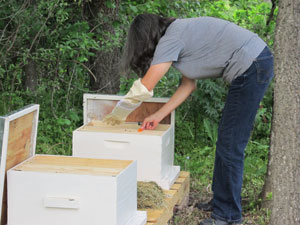

Step 4: Quickly place the outer cover over the hives, so the bees don't escape, and you're done. Here's what the hive looks like at this point:

This week I'll tell you how I got the bees out of the shipping box, and into the hive. This process is called "hiving" the bees.
Hiving Bees in 4 Easy Steps (actually, I found it rather challenging, but it looks easy!)
Step 1: There's a metal syrup can blocking the hole of the shipping box to keep the bees from escaping. Remove the can and reach into the box (yes, into a box of buzzing, possibly stinging bees) to get the queen cage out. Quickly replace the can or the bees will escape before you want them to.
Step 2: Remove the little cork at the end of the queen cage. On the other end of the cage is a marshmallow stopper that you leave in place. Then you put the queen cage into the hive body between two of the frames.
As I mentioned last week, this stage is critical. At this point the queen is a stranger to the bees in the shipping box, and if you put them all together in the hive, they will kill the queen.
Step 3: Remove the syrup can and shake the bees out of the shipping box and over the frames holding the queen cage.
In two or three days you open the hive and remove the queen cage. If all has gone well it will be empty because the bees will have eaten through the marshmallow stopper and released the queen. Since the bees have had a few days to get used to her smell while they were eating the marshmallow, they will accept her.
If something goes wrong, such as they eat through the marshmallow to quickly, or don't like the queen's smell, they will kill her. In that case you'd have to quickly get a replacement queen, since a hive without a queen will die in a few weeks.
Hive Maintenance
Once you've done the hiving, bees require little maintenance until it's time to harvest the honey (usually in August or September in our area). Each month I check the hive to ensure the queen is still there and that the bees are filling the frames with brood and honey. So far, so good!
Sunday, September 23, 2012
All about my bees
Why Bees?
People are always asking me why I got started with beekeeping. It's really simple: I like honey, and I like to know where my food is coming from. So after I started raising chickens and growing my own vegetables, bees seemed like a natural extension of my "live close to the earth" philosophy. About 3 years ago I started learning about bees, and what I learned is...there’s a lot to learn!
- Medium size hive body (where the queen lives and lays her eggs)

Bees are available for shipment in early spring, just before the honeyflow begins. You can have your bees shipped through the mail, but I decided to pick mine up since my rural mail service is very unreliable.
People are always asking me why I got started with beekeeping. It's really simple: I like honey, and I like to know where my food is coming from. So after I started raising chickens and growing my own vegetables, bees seemed like a natural extension of my "live close to the earth" philosophy. About 3 years ago I started learning about bees, and what I learned is...there’s a lot to learn!
Beekeeping Equipment
And not only is there a lot to learn, but there’s also a lot of equipment you need. Here’s what’s needed (at a minimum), for just one hive:
And not only is there a lot to learn, but there’s also a lot of equipment you need. Here’s what’s needed (at a minimum), for just one hive:
- Medium size hive body (where the queen lives and lays her eggs)
- 10 frames for the hive body (a frame is a wooden rectangle with a plastic or wax insert so bees can lay eggs and draw out honeycomb)
- 2 smaller size hive bodies called honey supers with 10 frames each (these are where surplus honey is made and stored)
- Bottom board (keeps insects out and gives the bees a landing platform)
- Telescoping outer cover (seals over the edges to keep moisture out)
- Smoker (for calming the bees)
- Hive tool (for cleaning the hive or opening hive body)
- Bee suit and gloves (if you don't want to get stung)
- 10,001 bees (more on this later)
- 2 smaller size hive bodies called honey supers with 10 frames each (these are where surplus honey is made and stored)
- Bottom board (keeps insects out and gives the bees a landing platform)
- Telescoping outer cover (seals over the edges to keep moisture out)
- Smoker (for calming the bees)
- Hive tool (for cleaning the hive or opening hive body)
- Bee suit and gloves (if you don't want to get stung)
- 10,001 bees (more on this later)
I accumulated my equipment over the course of last winter, thanks in large part to my friend Tom, who built the hive bodies and honey supers for me, as well as the bottom board and outer cover. What Tom couldn't make I bought from my favorite bee store, Dadant.
Ordering Bees
I ordered my bees on-line in early November 2011 from Beeweaver Apiaries in Navasota, Texas. Bees are usually sold in packages, which contain about three pounds of bees (around 10,000). A package of that size is enough to start one hive.
The bees are in a screened shipping box with a round hole in the top for a can of sugar syrup to provide food for the bees during shipment.
If you're starting a new hive, as opposed to adding to an existing hive, you need a queen; in that case you would have about 10,001 bees. She is placed inside the shipping box, along with the bees, but in a small wooden box called a queen cage. This is to keep her separated from the bees until installation in the hive.
Here’s a picture of two bee packages:
I ordered my bees on-line in early November 2011 from Beeweaver Apiaries in Navasota, Texas. Bees are usually sold in packages, which contain about three pounds of bees (around 10,000). A package of that size is enough to start one hive.
The bees are in a screened shipping box with a round hole in the top for a can of sugar syrup to provide food for the bees during shipment.
If you're starting a new hive, as opposed to adding to an existing hive, you need a queen; in that case you would have about 10,001 bees. She is placed inside the shipping box, along with the bees, but in a small wooden box called a queen cage. This is to keep her separated from the bees until installation in the hive.
Here’s a picture of two bee packages:
You can see the syrup cans in the top, and the orange straps are holding the queen cages.
Bees are available for shipment in early spring, just before the honeyflow begins. You can have your bees shipped through the mail, but I decided to pick mine up since my rural mail service is very unreliable.
Getting the Bees
So in early April I drove to Navasota, about 3 1/2 hours from my house. The drive there was uneventful; the drive back was exciting. I picked up probably 100 or so hitchhiker bees--bees just flying around the apiary that were attracted to the sugar syrup can in the shipping box and hung onto the box when I put it into my car. I had not planned on that!
So in early April I drove to Navasota, about 3 1/2 hours from my house. The drive there was uneventful; the drive back was exciting. I picked up probably 100 or so hitchhiker bees--bees just flying around the apiary that were attracted to the sugar syrup can in the shipping box and hung onto the box when I put it into my car. I had not planned on that!
The good news was that 10,001 of the bees were contained; the bad news was that there were a lot of bees just flying around inside my car. It takes a lot of concentration and willpower to drive for 3 1/2 hours with bees flying around your face!
I thought my adventure was almost over when I got home, but it was only just beginning. What I thought would be the easiest task, hiving the bees (installing them in the hive), was actually harder than it looked.
Next Week....Hiving the Bees.
Wednesday, September 12, 2012
On predators and prey
My country life involves a carefully orchestrated dance
to keep predators separated from prey. On a good day, all goes well, and no one dies. Today was not a good day.
My dogs like to hunt in a pack and are unapologetic
killers. If something moves, they go after it. And they don’t discriminate
between animals we regularly encounter in nature, (wild pigs, skunks, armadillos,
mice, snakes, porcupines, and raccoons), and my animals (cats and chickens).
Nor do the cats differentiate between birds and my chickens!
So I follow a complex schedule to try to keep all the animals,
domestic and wild, alive. After the sun is up and the wild animals have had time to
return to their daytime hiding places, I walk the dogs. I get home in under an
hour; the dogs typically disappear for a few hours.
Once they return, I lock the dogs in the backyard, and
then the chickens get their turn to free range. When the chickens are put up
for the night, the cats go outside, but either hide in the barn or come back inside before I take the dogs for their evening walk.
Today I wanted to get to school early, so I deviated from
my normal schedule. I took the dogs out well before sunrise, and we surprised a
large female raccoon just returning, no doubt, from a pleasant evening of doing whatever raccoons do. The dogs chased her,
and in the panic, she climbed up a small willow tree just a few feet above ground. The dogs were able to easily pull her out of the tree. I tried to get them
off of her, but I am no match for 6 large dogs with finely honed hunting
skills. They killed her.
I obviously didn’t know this raccoon, but I mourn her
loss. I am haunted by the terror she must have felt that last minute of her life, and the knowledge that had our paths not crossed, she would still be alive.
I am reminded once again how fragile life is, and the
importance of keeping to my schedule.
Sunday, September 9, 2012
Mystery in the henhouse
Exactly what’s
up when the egg count's down? Since my hens started laying in September, 2010, I've kept a daily record of the number of eggs laid. But something hasn't been right for several days now.
From my 14 laying hens (20 pullets, hatched in May, have yet to lay), I normally get 10-12 eggs per day, but lately that has dropped to about 8 eggs per day.
From my 14 laying hens (20 pullets, hatched in May, have yet to lay), I normally get 10-12 eggs per day, but lately that has dropped to about 8 eggs per day.
I’ve thought and rethought the many
alternatives:
-
the
extremely hot and dry weather we’ve had here in south Texas
-
early
molt (and that would be a very early molting season)
-
hidden
nest where they sneak off to lay eggs
when they’re free-ranging (not unheard of with these girls!)
-
fear
from the howling coyotes at night or constantly circling chicken hawks in the
daytime
-
illness
or disease
I’m happy to
report that the mystery was solved today. When I went to collect eggs, I
noticed the girls were a little more chatty (or should I say clucky) than
normal, but didn’t think too much of it.
When I
reached into the top row of nesting boxes I got quite a shock. There was a large chicken snake with its
unhinged jaw around an egg. Without thinking, I grabbed it by the tail and threw
it on the ground, which had the nice effect of getting the snake out of the
hen house, and the egg out of its mouth (unbroken too, for the record).
Then I had to
deal with a very angry, but fortunately not poisonous snake. Did you know that
chicken snakes will strike, just like a water moccasin or rattlesnake? I didn’t
either, and believe me it’s pretty scary when it does.
The happy
ending to the story is that I didn’t get bitten, and the chicken snake didn’t
get killed. I put it in a pillow case and released it down by the river, at
least ¾ of a mile away from the hen house. Here’s a cell phone picture (I
apologize for the quality) of me holding the snake before I took it down to the
river.

Sunday, September 2, 2012
Morning coffee
"Give fools their gold, and knaves the power, let fortune's bubbles rise and fall: who sows a field, or trains a flower, or plants a tree, is more than all." - John Greenleaf Whittier
I don't know if it's just my normal unbounded enthusiasm, but I think there's a touch of fall in the air this morning. Sitting outside with my morning coffee and watching the sun rise, there's a little fog over the lakes below the hill, and my thoughts fly to all the outdoor projects I can get done in the coolness of this almost fall day.
Since there's no hay to harvest because of the drought, the field needs to be shredded, and then there's the fallen oak branches to cut for firewood, and the beehives to check, and the chickens to feed and water, and the dogs to walk, and the land around the lakes and river to mow, and.....the list goes on and on.
But for now, before the day turns hot, and dusty, and dry, I'm content to sip my coffee, pet the dogs, and think about how very fortunate I am to live the country life. The work will wait, but this beautiful sunrise will be gone all too quickly!

I don't know if it's just my normal unbounded enthusiasm, but I think there's a touch of fall in the air this morning. Sitting outside with my morning coffee and watching the sun rise, there's a little fog over the lakes below the hill, and my thoughts fly to all the outdoor projects I can get done in the coolness of this almost fall day.
Since there's no hay to harvest because of the drought, the field needs to be shredded, and then there's the fallen oak branches to cut for firewood, and the beehives to check, and the chickens to feed and water, and the dogs to walk, and the land around the lakes and river to mow, and.....the list goes on and on.
But for now, before the day turns hot, and dusty, and dry, I'm content to sip my coffee, pet the dogs, and think about how very fortunate I am to live the country life. The work will wait, but this beautiful sunrise will be gone all too quickly!

Subscribe to:
Posts (Atom)